| Concept | Description |
|---|---|
| One-Tailed vs. Two-Tailed Tests | |
| One-Tailed Tests | Tests for an effect in one specified direction only, e.g., whether a new fertilizer increases yield; more powerful in that direction |
| Two-Tailed Tests | Tests for an effect in either direction, e.g., whether a new seed variety's yield differs from the standard; more conservative |
| Choosing Between Them | The choice should follow the research question, decided before seeing the data, not switched afterward to chase significance |
36 One-Tailed vs. Two-Tailed Tests
A hypothesis test can be one-tailed or two-tailed, depending on how the alternative hypothesis is framed. Both approaches test whether there’s enough evidence to reject the null hypothesis. They differ in whether the test considers just one direction of effect, or both.
36.1 One-Tailed Tests
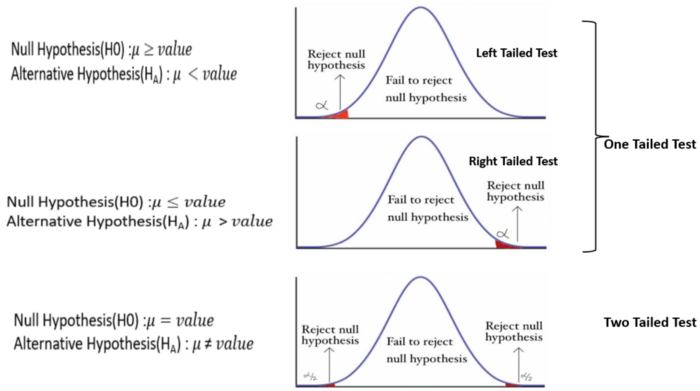
A one-tailed (directional) test is used when the research hypothesis specifies a direction (greater than, or less than) rather than just “different.” It tests for an effect in one specific direction only, ignoring the other. Because all of the test’s statistical power is concentrated on that one direction, a one-tailed test is more sensitive to an effect in the specified direction than an equivalent two-tailed test.
When to use:
- The hypothesis specifically claims one variable is greater than (or less than) another.
- Missing an effect in the untested direction has no real consequence for the decision at hand.
Example: a cooperative is trialing a new bio-fertilizer and specifically wants to know whether it increases yield compared to the standard fertilizer. Not whether it changes yield in either direction. That’s a one-tailed test: \(H_0\): the new fertilizer does not increase yield; \(H_a\): the new fertilizer increases yield.
36.2 Two-Tailed Tests
A two-tailed (non-directional) test is used when the research hypothesis doesn’t specify a direction. Only that there’s some difference. It checks for an effect in either direction, which means it needs stronger evidence than a one-tailed test to reach the same conclusion, since that evidence has to rule out both directions.
When to use:
- There’s no specific direction in mind, or any significant difference (better or worse) matters.
- Missing an effect would be equally costly in either direction.
Example: an agricultural university is trialing a new seed variety and wants to know whether it performs differently from the standard variety, without presupposing whether that difference would be an improvement or a decline. That’s a two-tailed test: \(H_0\): the new variety’s yield is no different from the standard variety’s; \(H_a\): the new variety’s yield is different (higher or lower).
36.3 Choosing Between One-Tailed and Two-Tailed Tests
The choice should follow from the research question, decided before looking at the data. Not chosen afterward to make a borderline result “significant.” One-tailed tests are more powerful for detecting an effect in the direction specified, but at the cost of being unable to detect an effect in the other direction at all. A fertilizer that unexpectedly reduced yield would show up as “not significant” in a one-tailed test built only to detect an increase. Two-tailed tests are more conservative and are the safer default whenever there’s genuine uncertainty about direction.
Considerations:
- Research hypothesis: let the directionality of the actual question decide, not a preference for a smaller p-value.
- Potential for bias: switching to a one-tailed test after seeing a two-tailed result fall just short of significance is a well-known form of p-hacking, and undermines the test’s validity.
- Field conventions: some fields lean toward two-tailed tests by default, treating a one-tailed test as needing explicit justification, worth checking what’s standard for agricultural trials specifically before defaulting to one-tailed.